
Hydrolyzed sugar kelp for soil health and plant growth
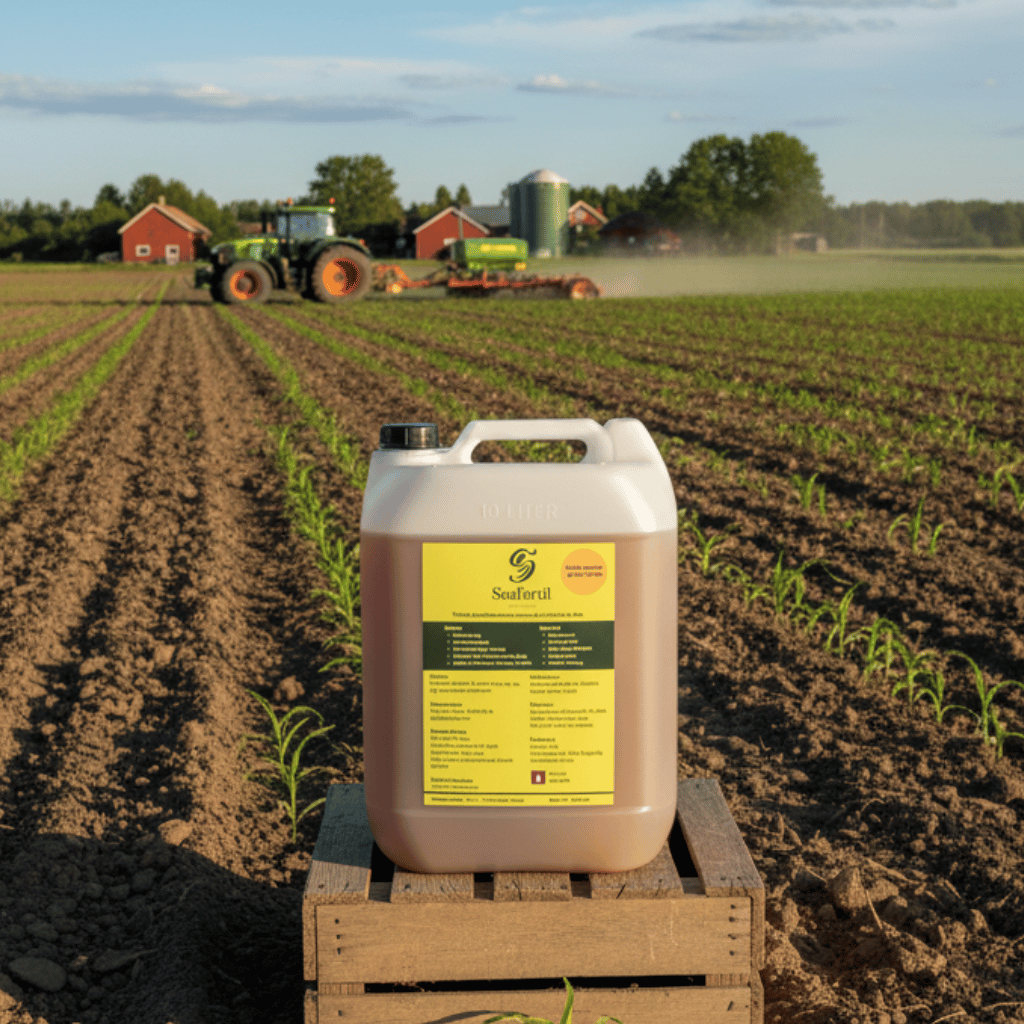
Natural microbial biostimulant rich in nutrients and amino acids for optimal plant uptake. Made from hydrolyzed Norwegian sugar kelp and enriched with Trichoderma harzianum.
Why use kelp-based biostimulants on seeds, roots, and foliage?
Kelp has been used in Norwegian agriculture for centuries, particularly in coastal regions where seaweed was collected and applied directly to fields to improve soil structure and nutrient availability. This tradition reflects a simple principle: using locally available biological resources to strengthen soil and plant systems.
Modern research has helped explain why this works.
Kelp extracts contain naturally occurring compounds such as polysaccharides, trace elements, and plant signaling molecules that can support root development, improve nutrient uptake, and help plants cope with environmental stress. These effects have been observed across a range of crops, including cereals, vegetables, and fruit production systems.
However, the effect of kelp alone is only part of the story.
When combined with beneficial microorganisms such as Trichoderma, the interaction between plant, soil, and biology becomes more dynamic. Trichoderma can colonize the root zone, contribute to the breakdown of organic material, and support nutrient availability through biological activity in the soil.
This combination does not replace fertilization — but it can improve how efficiently plants utilize existing nutrients and respond to their growing environment.
At Seafertil, we focus on developing these biological interactions in a controlled and consistent way, aiming to support both plant performance and long-term soil health.
Mineral Content
| Parameter | w/w % |
|---|---|
| Potassium (K) | 1.2609 % |
| Sodium (Na) | 1.1896 % |
| Magnesium (Mg) | 0.0866 % |
| Sulfur (S) | 0.0859 % |
| Calcium (Ca) | 0.0495 % |
| Total phosphorus (P) | 0.0139 % |
| Iron (Fe) | 0.00015 % |
| Zinc (Zn) | 0.00009 % |
| Copper (Cu) | 0.00003 % |
| Manganese (Mn) | 0.00002 % |
Amino Acid Content
| Amino Acid | w/w % |
|---|---|
| Glutamic acid | 0.0414 % |
| Threonine | 0.0220 % |
| Alanine | 0.0192 % |
| Leucine | 0.0153 % |
| Lysine | 0.0134 % |
| Valine | 0.0132 % |
| Glycine | 0.0131 % |
| Phenylalanine | 0.0129 % |
| Proline | 0.0127 % |
| Aspartic acid | 0.0126 % |
| Isoleucine | 0.0116 % |
| Tyrosine | 0.0094 % |
| Serine | 0.0084 % |
| Arginine | 0.0072 % |
| Hydroxyproline | 0.0065 % |
| Methionine | 0.0054 % |
| Histidine | 0.0044 % |
| Total protein-bound amino acids | 0.2287 % |
Sugar kelp
Sugar kelp is rich in alginate, which improves soil structure and water retention. It also contains minerals, fiber, and bioactive compounds that promote healthy plant growth.
Source: snl.no
Use of Seafertil

| Application Purpose | Crop | Dosage | Comment (effect) |
|---|---|---|---|
| Foliar application | Grain | 2–3 dl/daa (1–2 times) | Indirect effect via leaves and microbial stimulation, but less effective than soil application |
| Foliar application | Grass | 2–3 dl/daa | Can enhance plant health, but the main effect comes through the soil |
| Foliar application | Vegetables | 2–4 dl/daa | Can reduce stress and improve plant vitality |
| Foliar application | Fruit trees | 3–5 dl/daa | Limited direct effect, more supportive to plant health |
| Foliar application | Berries | 2–4 dl/daa | Can contribute to better resilience |
| Soil/root treatment | Grain | 3–6 dl/daa (1–2 times) | Increases nutrient uptake and root development |
| Soil/root treatment | Grass | 3–6 dl/daa | Improves soil biology and regrowth after cutting |
| Soil/root treatment | Vegetables | 4–8 dl/daa | Strong effect on root environment and nutrient mobilization |
| Soil/root treatment | Fruit trees | 5–10 dl/daa | Better root growth and nutrient availability |
| Soil/root treatment | Berries | 4–8 dl/daa | Important for establishment and fruit set |
| Seed treatment | Grain | 0.02–0.05 dl/daa seed amount | Colonizes roots early and provides better establishment |
| Seed treatment | Grass | 0.02–0.05 dl/daa | Better germination and root development |
| Seed treatment | Vegetables | 0.03–0.06 dl/daa | Increases germination vigor and early growth |
| Seed treatment | Berries / small plants | 1–2 ml/L (root dip) | Rapid establishment and less transplant shock |
General approach to dosage
| Method | Dosage |
|---|---|
| Seed | 1–2 ml/L |
| Root | 1–3 ml/L |
| Foliar | 0.5–1.5 ml/L |
| Frequency | 7–10 days |
Areas of use
| Application | Crop | Dosage | Frequency / period | Effect / comment |
|---|---|---|---|---|
| Seed treatment | Small seeds (lettuce, herbs) | 1 ml/L | 1–2 hours before sowing | Even germination and rapid establishment |
| Seed treatment | Large seeds (tomato, cucumber) | 1–2 ml/L | 4–8 hours before sowing | Strong root initiation |
| Soil / root treatment | All crops | 1–3 ml/L | At sowing/transplanting, then every 5–10 days | Better root development and nutrient uptake |
| Foliar application | All crops | 0.5–1.5 ml/L | Start at 2–3 leaves, then every 7–10 days | Increased growth and stress resistance |
Vegetables
| Crop | Seed (ml/L) | Root (ml/L) | Foliar (ml/L) | Frequency | Comment |
|---|---|---|---|---|---|
| Lettuce | 1 | 1–2 | 0.5–1 | 7–10 days | Even growth and quality |
| Tomato | 2 | 2–3 | 1–1.5 | 7–10 days | Important during flowering/fruiting |
| Cucumber | 2 | 2–3 | 1 | 7 days | Reduces stress |
| Bell pepper | 1–2 | 2 | 1 | 7–10 days | Strengthens establishment |
Herbs
| Crop | Seed (ml/L) | Root (ml/L) | Foliar (ml/L) | Frequency | Comment |
|---|---|---|---|---|---|
| Basil | 1 | 1–2 | 0.5–1 | 7–10 days | Dense growth and aroma |
| Cilantro | 1 | 1–2 | 0.5 | 7–10 days | Better germination |
| Thyme | 1 | 1 | 0.5 | 10–14 days | Avoid overdosing |
| Parsley | 1–2 | 2 | 1 | 7–10 days | Important for germination |
Flowers
| Crop | Seed (ml/L) | Root (ml/L) | Foliar (ml/L) | Frequency | Comment |
|---|---|---|---|---|---|
| Petunia | 1 | 1–2 | 0.5–1 | 7–10 days | Even growth and flowering |
| Geranium | 1 | 2 | 1 | 7–10 days | Strong plant development |
| Pansy | 1 | 1–2 | 0.5 | 10 days | Compact growth |
| Ornamental kale / others | 1–2 | 2 | 1 | 7–10 days | Robust plant |
General recommendations
| Topic | Recommendation |
|---|---|
| Dosage | Use lower doses frequently rather than high doses infrequently |
| Timing | Apply before/after stress (cold, drought, repotting) |
| Miscibility | Can often be mixed with fertilizer/plant protection products (test first) |
| Hydroponics | Avoid overdosing → may cause biofilm |
Scientific documentation on the effect of kelp-based biostimulants
| Study / trial | Direct link to publication | Type of documentation | Treatment | Key findings | Di Mola et al. 2023 – Agronomy | mdpi.com/2073-4395/13/3/901 | Peer-reviewed article | Ascophyllum nodosum + Trichoderma afroharzianum | approx. 23% higher yield and improved phenolic content. The study shows a significant increase in both yield and quality parameters. |
|---|---|---|---|---|
| Staropoli et al. 2024 – Journal of Fungi | mdpi.com/2309-608X/10/2/97 | Peer-reviewed article | kelp extract + Trichoderma | influences metabolism and plant vitality. Findings indicate increased activity in shoots and roots, as well as improved nutrient uptake. |
| Chiomento et al. 2024 – Agronomy | mdpi.com/2073-4395/14/4/860 | Peer-reviewed article | kelp + Trichoderma + AMF | better plant growth and development. The combination of kelp, Trichoderma, and arbuscular mycorrhizal fungi produced synergistic effects on biomass and nutrient uptake. |
| Kusumawati et al. 2021 – IOP Conf. Series: Earth and Environmental Science | iopscience.iop.org/.../012059 | Peer-reviewed conference article | Sargassum + Trichoderma | the microorganism breaks down kelp carbohydrates and increases nutrient availability. This releases bound nutrients and makes them accessible to plant roots. |